
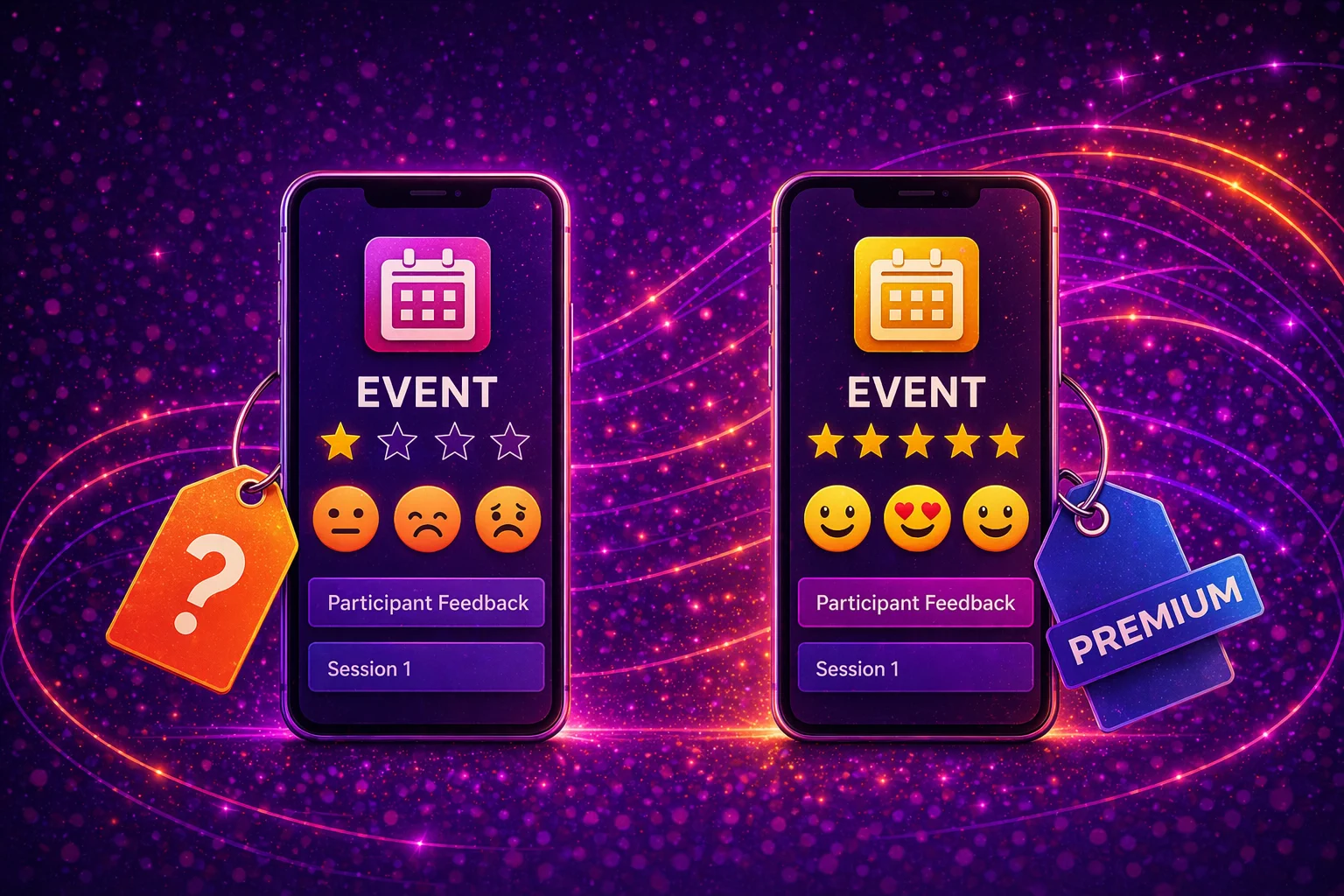
When collecting proposals in event technologies, one of the most common questions is price differences. Between two offers that appear similar in scope, there can sometimes be a striking budget gap. Both solutions may be presented as an event mobile application: it shows the agenda, includes participant information, has a QR screen, and can send notifications. That is why, at first glance, the question becomes natural: “If both do a similar job, why is one much lower and the other priced higher?”
In fact, the reason for this difference often starts not in what is visible on the screens, but in what is invisible behind them.
An event mobile application is not only a few designed screens. What makes the real difference is how the app works on event day, how stable it remains under heavy use, how quickly it adapts to changes, and how much operational relief it provides to the organization team.
Because once event day begins, the real capacity of the application becomes visible.
When participant entrances intensify, hundreds of people use QR at the same time, real-time notifications are sent, changes are made to the agenda, or personalized information is displayed concurrently, you directly feel how strong the system is built.
Structures that look similar from the outside diverge at this point.
Some solutions offer fixed structures that meet basic needs, while others have the operational strength to carry the entire event. Especially in high-attendance organizations, this difference is not only a technical topic; it becomes a factor that directly affects the event flow.
Structures That Look Similar From the Outside Are Not Actually the Same
Event mobile applications are often described with the same headings:
- agenda flow
- speakers
- notifications
- QR code
- participant information
But having these headings alone is not enough. What truly matters is how flexibly these modules work, how quickly they can be managed, and how well they can adapt to event-specific needs.
For example, in a small event, showing only the agenda may be enough. But as participant numbers grow, needs diversify quickly.
- personalized flight information
- transfer planning
- hotel details
- room access rules
- reserved sessions
- gala seating
- special user segments
At this point, the system needs to go beyond a standard template.
This is where the price difference often begins.
Because not every application provides the same level of flexibility.
What Kind of Infrastructure Is Behind the App?
The most critical area that is not visible to the user is the technical infrastructure.
Especially in high-attendance organizations, having hundreds of people log in, scan QR, view content, and receive notifications at the same time requires serious infrastructure.
During peak usage moments, the system must not slow down, must run without interruption, and must manage data flow healthily.
These moments become critical especially:
- entry peaks
- bulk QR usage
- real-time notification sending
- simultaneous data updates
- viewing media content
Strong infrastructure makes the difference in these areas.
Because for the user, the application is evaluated simply as “it works” or “it does not work.”
The technical difference is invisible, but its impact is very clear.
Operational Support Is One of the Most Important Factors That Determines Price
An event mobile app is not a product that is published and then left alone.
An event is a living process, and changes often happen within the planned flow.
- a speaker time can change
- a room can change
- transfer information can be revised
- a new notification need can arise
In such cases, it is not enough for the system to only be set up; the process must be manageable throughout the event.
This is where the event app approach makes the difference.
Because event app offers not only “delivering an app,” but an approach of managing the event’s digital flow together.
This brings these advantages:
- real-time content updates
- fast notification planning
- segment-based communication
- ease of operational intervention
On event day, this support difference is felt very clearly.
Why Is Flexible Development Capability Important?
Each event produces different needs within itself.
Templates may be sufficient for some organizations; however, in large and special projects, new needs often appear.
For example:
- flight information card
- transportation reservation screen
- roommate module
- personalized entitlement management
- special QR scenarios
- user-based screens
For such needs, the system must be flexible.
Not every structure can provide this at the same speed.
Conclusion
Two solutions can be presented from the outside with the same headings. Both can be defined as an event mobile app.
But the real difference appears in this question:
When event day comes, how strong will this structure perform?
Real value is often understood not on design screens, but under heavy usage, in moments of change, and inside operations.
That is why the price difference is not only cost; it is often the difference in scope, trust, and operations.
The key point that differentiates the event app approach is exactly this: not only delivering a working app, but carrying the event’s digital flow with confidence.