No matter how detailed the planning is, once an event moves into the field, some changes become inevitable. The agenda may have been prepared weeks in advance, all content may be finalized, and the participant flow may have been mapped. Still, once event day begins, many small details can be reshaped. This is a natural part of the event industry. What matters is not that change happens, but how fast and how controlled it is managed.
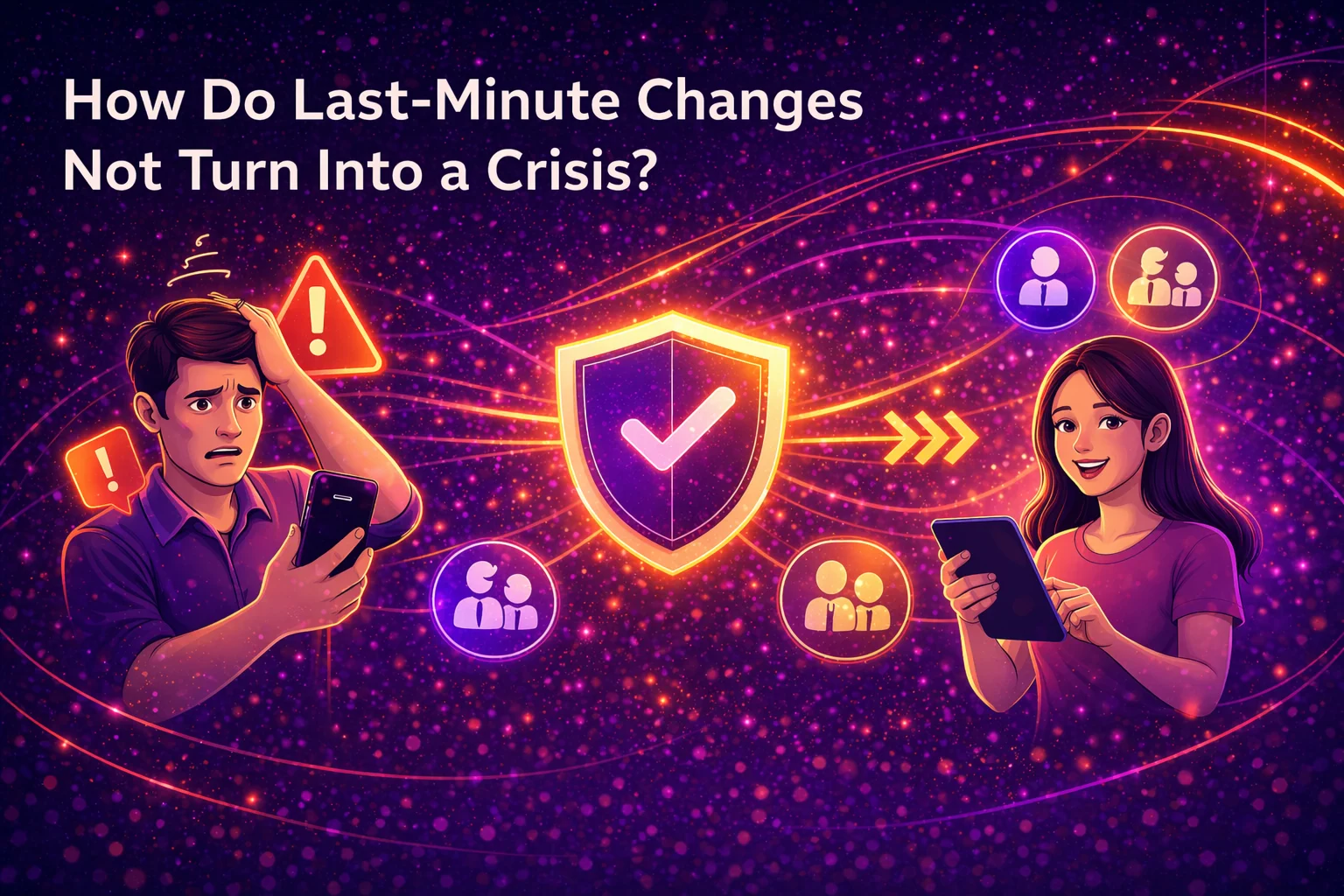
Because in most cases, what breaks the flow is not the change itself, but the failure to deliver information to the right people at the right time.
A speaker’s stage time can be delayed by a few minutes. One of the parallel sessions can run longer than planned. Rooms can change. Transfer times may need revision. Weather conditions can affect outdoor plans. A technical issue can require the content order to change. These are completely normal, especially in large organizations. But if the information flow is not strong, changes that seem small can quickly turn into uncertainty for participants.
When participants do not know which room they should go to, cannot access up-to-date information, or are not aware of a change that affects them, the event flow starts to look uncontrolled from the outside. Yet in many cases, the organizing team has already solved the issue; only the distribution of information has been delayed.
That is why, in professional event operations, last-minute changes are handled as a separate operational topic.
Especially in events with high participant volume, delivering the right information to everyone at the same time becomes difficult with traditional methods. Not everyone sees an email instantly. Information gets lost in group messages. Calling participants is not sustainable. Verbal guidance from field teams is only effective in limited areas.
In these cases, centralized digital communication makes a major difference.
When the app in the participant’s hand becomes the current information center, changes move forward in a much more controlled way. Because once new information is entered into the system from a single point, it appears on the participant’s screen at the same time.
For example, if a session room changes, the agenda inside the app can be updated instantly. When the participant checks the agenda, they see the new room information. If the change concerns a specific participant group, a push notification can be sent only to the relevant people.
This structure prevents a small change from growing into a bigger problem.
The most critical difference shows up here: once information becomes visible to everyone, the change stops being a crisis.
In last-minute notifications, targeting matters as much as speed.
Because not every change concerns everyone.
Some situations affect only specific participants:
- participants in a specific transfer group
- those staying at a specific hotel
- participants registered only for the relevant session
- VIP guests
- participants who will attend a private meeting
That is why segment-based communication is highly valuable.
For example, if a transfer time changes, only participants on the relevant transfer list receive the notification. This prevents information noise and helps each participant clearly see what is relevant to them.
Push notifications are an especially strong tool for managing last-minute changes in a controlled way.
Even if the participant is not actively using the app, they can reach the information directly on their phone screen.
For example:
- "Your 14:30 session will now take place in Hall B."
- "Your transfer will depart from the main entrance area in 10 minutes."
- "The evening gala will begin at 20:30."
Clear, timely messages like these help participants adapt quickly.
Here, not only sending the information matters, but also the language of the message.
Messages sent during the event should be short, clear, and directive. Participants do not read long explanations; they want to understand what changed and what they should do immediately.
Last-minute changes can also create pressure for the organizing teams.
Because interventions are needed across many points at the same time:
- content updates
- room guidance
- field briefing
- technical coordination
- participant communication
If the digital system is not strong, teams face a large number of repeated questions.
- "Which room is it now?"
- "Did the agenda change?"
- "What time is the transfer?"
- "Is my session the same?"
As more of these questions are resolved through the app, the load on teams decreases significantly.
In fact, in a well-functioning system, the participant often does not notice the operational difficulty of the change, because the information reached them on time.
This is where an event starts to look professional.
For participants, what matters is that everything is still flowing. Even if a change happened, when the process is under control, the event preserves a sense of trust.
This is one of the main reasons strong digital infrastructures are preferred in large organizations today. Because there is almost no event without change; what makes the difference is how calmly the change is managed.
That is why a well-designed event app is necessary not only to show the planned flow, but also to manage the changing flow.
Because real operational strength often shows itself when the plan breaks.