Corporate events may look like organized structures moving around a defined agenda. But when you step into the operational side, it becomes clear that participant management is one of the most critical topics. Because in corporate organizations, success is tied not only to well-planned content or the right venue choice, but also to how controlled and smooth the participant journey is throughout the process.
Especially as participant numbers grow, the structure contains more detail. Not every guest’s flow is the same. Some arrive from different cities, some reach the venue at different times, some attend only specific sessions, and some are included in private meeting schedules. Accommodation plans, transfer arrangements, room access rules, and content needs can differ from person to person.
That is why participant management in corporate events does not only mean “creating a guest list.” You need to plan who arrives when, what information each person will need, what content they can access, and which flow they are part of during the event.
The reason participant management becomes difficult starts exactly here: even though everyone is in the same event, not everyone lives the same experience.
In one organization, the general program may be enough for some participants, while for others flight information, transfer details, accommodation information, special session registrations, or access to different areas become critical. When information is delivered as one-size-fits-all, the structure can quickly become complex.
In manual systems, information is often split across different tools. Guest lists are kept in one place, transfer information is tracked in another spreadsheet, session participation is followed in separate files, and last-minute changes are shared through different channels. As participant numbers grow, this creates serious time loss for organization teams.
The process also becomes harder for participants. Which information is current and which detail applies to them may not be clear. Especially when event day starts, repeated questions increase:
- What time is my transfer?
- Which room am I in?
- Did my agenda change?
- What are my accommodation details?
- Which session did I reserve?
At this point, centralizing participant management makes a major difference.
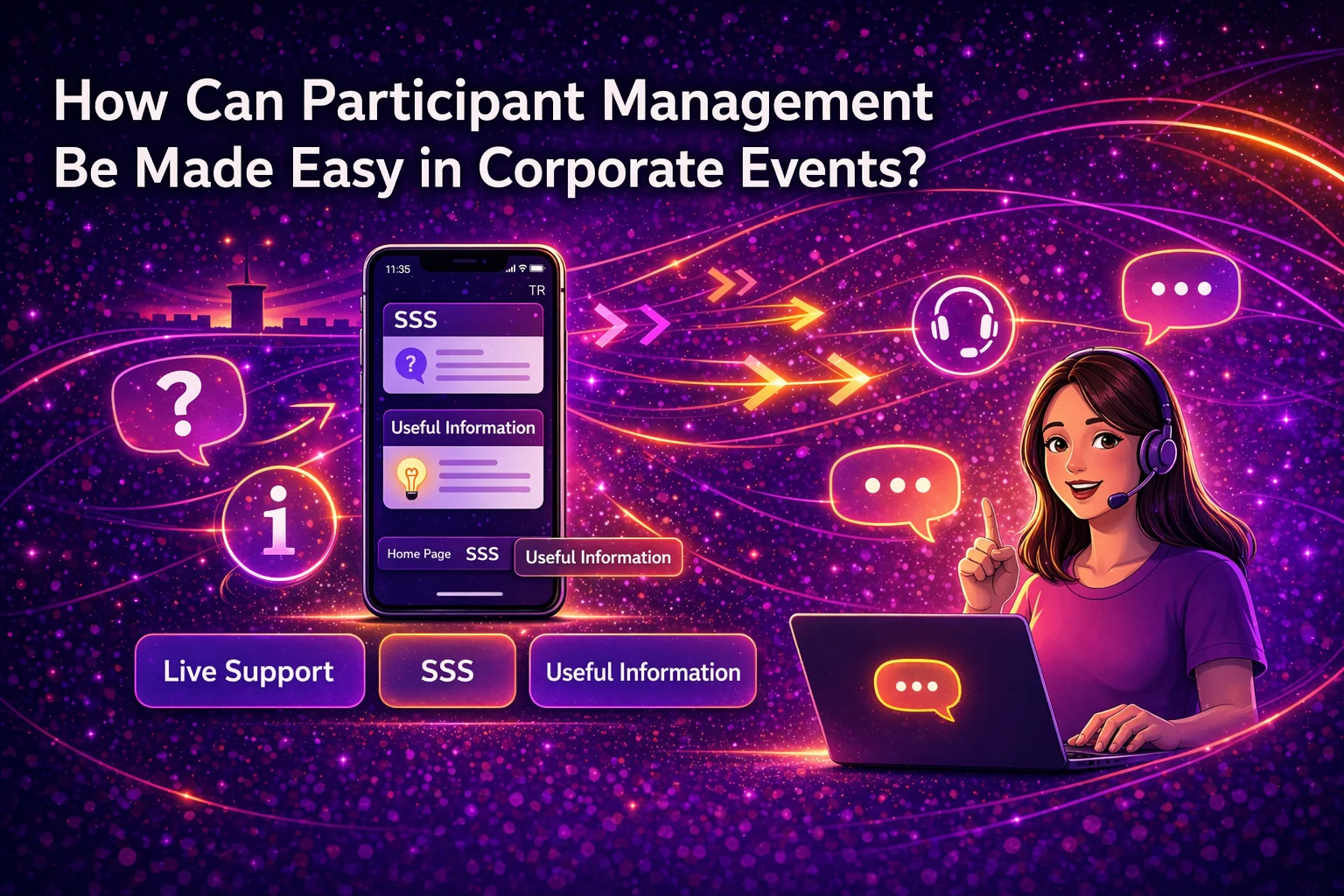
With a well-built digital structure, the participant can manage their entire event journey through a single platform. When they can access their own information from one point, the process moves in a much more controlled way.
From the moment a participant is invited, the information they may need includes:
- registration and entry information
- QR code access
- the current agenda flow
- personal session plan
- flight information
- transfer times
- accommodation information
- room details
- announcements specific to them
Being able to show this information to each participant personally creates a serious operational advantage in corporate events.
For example, a participant arriving from out of town can see only their own flight card inside the app. They can learn which transfer vehicle to take, which hotel they will stay at, access their room details, and follow their daily schedule personally.
This structure does not only provide comfort for the participant; it also reduces the workload of the organization team.
Because most questions received by field teams are about personal details. Instead of answering each one by one, enabling the participant to reach the right information on their own screen significantly improves operational quality.
Another important factor that makes participant management easier in corporate events is segmentation.
Sending every piece of information to everyone is often not the right approach.
Some information matters only for specific groups:
- a specific transfer group
- participants staying at a specific hotel
- those included in a private meeting
- VIP participants
- specific departments or teams
That is why segment-based communication provides a major advantage.
With personalized content display and targeted notifications, information noise decreases and participants see only the details that matter to them.
In corporate events, this simplification also strengthens the perception of professionalism.
Because for participants, a well-organized event is often an event where information is easy to reach.
Another critical topic is the management of changes.
During the event, unplanned developments can happen:
- a room may change
- a meeting time may shift
- transfer times may be revised
- additional briefing may be needed
In such cases, having participant management centralized is a major advantage.
When information is updated from a single point, everyone reaches the current data.
In corporate events, the real quality often appears in the invisible flow.
If participants move through the day without disruptions, do not have to search for information, and clearly know when and where they need to be, the organization feels professional.
That is why strong participant management is one of the most important building blocks of corporate events today.
And what makes the difference is not only informing people, but delivering the right information to the right person at the right time.